


Charlevoix
MICHIGAN
SIP & SAVOR | WANDER & WONDER | PUBLIC RESTROOMS
Downtown Charlevoix, MI

The Mushroom Houses of Downtown Charlevoix
SELF-GUIDED WALKING TOUR
TOTAL DISTANCE 1 mi | 1.5 km
ELEVATION GAIN 43 ft | 13 m

Savor & Sip

Where to dine and unwind in downtown Charlevoix.

Bridge Street Tap Room
A lively waterfront alehouse overlooking Round Lake, this locally focused taproom pairs a deep Michigan craft beer lineup with an elevated pub menu. Standouts range from inventive dishes like seafood curry ramen to crowd-pleasing pizzas and hearty sandwiches, all often built around regional ingredients. With indoor seating, a bustling patio, and a family-friendly vibe, it balances casual dining with scenic harbor views
$ $ $ $ $

Grey Gables Restaurant
A cornerstone of downtown dining, Bistro Bella Vita delivers a polished yet approachable take on French- and Italian-inspired cuisine. The kitchen’s commitment to scratch cooking shows in its home-made pastas, wood-fired pizzas, and carefully executed rotisserie meats. Guests consistently highlight the open-kitchen atmosphere, attentive service, and excellent cocktail and wine lists.
$ $ $ $ $

Margaritas Mexican Restaurant
A newer addition to downtown, this upbeat spot centers on classic Mexican favorites (fajitas, enchiladas, and increasingly popular birria tacos) paired, naturally, with a strong margarita program. Casual and colorful, it’s built for easygoing meals and lively evenings, with familiar flavors executed well and a menu that encourages sharing.
no website
$ $ $ $ $

Smoke On the Water
Blending smokehouse tradition with breakfast flair, this casual eatery offers slow-cooked barbecue alongside unexpected morning favorites like lemon curd pancakes and hearty omelets. The result is a menu that feels both indulgent and versatile, appealing to early risers and late lunch crowds alike, with a relaxed, small-town atmosphere.
$ $ $ $ $

That French Place
Part crêperie, part pâtisserie, this charming café brings a distinctly French touch to Charlevoix with delicate crêpes, flaky pastries, and house-made macarons. Light fare like quiche and espresso drinks round out the offering, making it an ideal stop for breakfast or a refined midday pause that feels lifted straight from a neighborhood boulangerie.
$ $ $ $ $

The Happy Troll
Opened by the O’Leary family, this nautical-themed spot is a true labor of local love, shifting from deli by day to full-service pub by night. Expect creative sandwiches, baked goods, and comfort-driven entrées—think indulgent breakfast dishes or inventive burgers—served in a welcoming, community-minded setting that reflects its family-run roots.
$ $ $ $ $

The Salad Fork
Fresh, fast, and health-forward, this bright café focuses on customizable salads, açaí bowls, and lighter fare like avocado toast and paninis. It’s a modern counterpoint to heavier Up North dining, emphasizing clean ingredients and quick service, perfect for a casual lunch that doesn’t sacrifice quality for convenience.
$ $ $ $ $
The Villager Pub
A classic small-town pub with a long-standing presence, The Villager leans into traditional American comfort food (burgers, pasta, and familiar bar staples) served in an unpretentious, convivial setting. It’s less about reinvention and more about consistency, offering a dependable, easygoing stop for locals and visitors alike.
$ $ $ $ $

Wander & Wonder
The Mushroom Houses of Charlevoix.
Please remember that these are people's private homes and property!

Earl Young
A self-taught architectural original, Earl Young left an indelible mark on Charlevoix with his stone cottages, dubbed “Mushroom Houses,” and nicknamed “Gnome Homes,” “Hobbit Houses,” or “Elf Cottages.” Defined by undulating rooflines, massive boulder walls, and hand-shaped timber details, he would build twenty-six residential houses and four commercial properties ... impressive for someone who was never formally educated as an architect.
Earl Young

Carriage House
Constructed in 1953, this residence showcases Young’s signature use of natural materials and flowing forms. The heavy stone base anchors a sweeping roofline that mimics organic shapes found in nature. Straight angles are largely avoided in favor of soft, continuous curves. The result is a compact yet highly expressive cottage design.
101 Grant Street
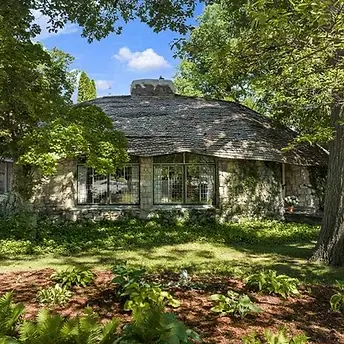
Mushroom House
Built in 1954, this is one of the most iconic “Mushroom Houses” designed by Earl Young - the nickname was born with this home. Its thick, undulating cedar-shingle roof appears to drape organically over massive glacial stone walls. Irregular windows and curved lines give the structure a hand-sculpted, storybook quality. It remains a defining example of Young’s imaginative architectural style.
103 Grant Street

The Pines
Dating to 1919, “The Pines” represents an early phase in Young’s architectural career. The design is more restrained, with a traditional structure softened by natural stone elements. Its integration with the surrounding landscape reflects a sensitivity that would define his later work. The home has a quiet, lodge-like character.
300 Park Avenue

Half House
Built in 1948, the “Half House” is one of Earl Young’s most visually puzzling creations, appearing almost as though a full cottage had been cleanly divided down the middle. Its sharply asymmetrical façade gives the structure a uniquely compressed, almost experimental feel. Unlike his more balanced designs, this house stands out for its deliberate incompleteness, a rare instance where Young leaned into imbalance to create something instantly recognizable.
302 Park Avenue

Thatch House
The Thatch House stands apart for its rare use of a true thatched roof, an Old World touch seldom seen in American residential design. Built in the 1930s, the home blends this European-inspired feature with Young’s signature fieldstone construction, creating a cottage rooted both in Michigan's topography and the English countryside. The thick, textured roofline gives the home an organic silhouette, contrasting beautifully with the solidity of the stone walls below.
304 Park Avenue

Waterfall House
Built in the early 1920s as Young's second personal residence, 306 Park Avenue reveals Earl Young refining ideas first tested next door. Here, the roofline begins to dip and swell more noticeably, wrapping low over the structure and anchoring it visually to the ground, while a prominent, irregular stone chimney acts as the home’s focal point. Unlike the more tentative feel of his first house, this residence shows greater confidence in massing and proportion.
306 Park Avenue
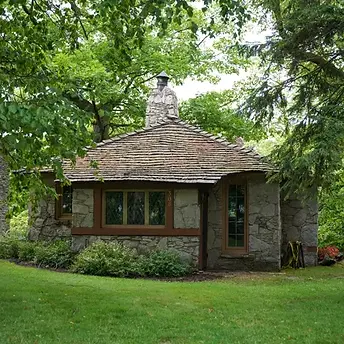
Betide
Built in 1937, “Betide” reflects a transitional moment in Young’s evolving style. The design retains some traditional symmetry while introducing softened lines and natural materials. Stonework plays a central role in shaping the structure’s visual identity. Its name adds a poetic dimension to its architectural presence.
308 Park Avenue

Abide
Constructed in 1935, “Abide” is one of Young’s earlier named works. Thick stone walls and a grounded profile emphasize solidity and permanence. Subtle curves hint at the stylistic direction he would later pursue more fully. The house conveys a sense of quiet retreat and endurance.
310 Park Avenue

Red Roof House
Often overlooked among Earl Young’s more flamboyant creations, the “Red Roof House” at 316 Park Avenue stands out for its comparatively restrained, almost storybook-cottage symmetry. Set slightly back from the street, it features a distinctive red shingle roof, twin stone archways, and finely detailed leaded-glass windows that give it a quieter, more domestic character.
316 Park Avenue

Residence at 303 Clinton
This is one of Earl Young’s lesser-documented works, known to have been remodeled by him between 1952 and 1962. Unlike his more iconic, purpose-built houses, this property represents his later-career practice of adapting existing structures rather than designing them from the ground up.
303 Clinton Street
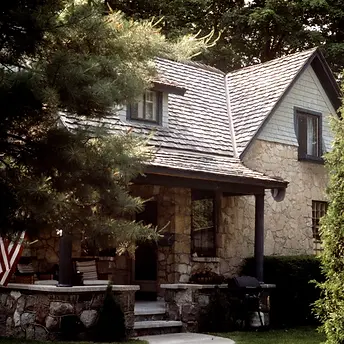
The Cottage
Unlike his low-slung, earth-hugging forms, this house is defined by its steep gabled roof and chalet-like profile, giving it a more vertical, Alpine character. Young’s influence appears in the textured fieldstone façade and rustic detailing, which soften the geometry and tie the building more closely to its surroundings.
305 Clinton Street

Weathervane Restaurant
Originally built in 1967, the Weathervane Restaurant is one of Young’s best-known public commissions. The structure combines timber framing with stonework to create a warm, lodge-like atmosphere. Its design adapts his residential style for a larger, communal setting. It remains a prominent architectural landmark in Charlevoix. Only open for dinner.
106 Pine River Lane

Weathervane Terrace
Completed in 1965, the Weathervane Terrace Inn represents Earl Young extending his signature stone aesthetic into mid-century hospitality. Designed as a U-shaped motel overlooking the Pine River channel, it balances functionality with his instinct for natural materials and informal layout. Distinctive fireplaces and richly textured stonework anchor the interiors, echoing the artistry of the nearby Weathervane Inn while adapting to a more modern lodging format.
106 Pine River Lane

Hotel Earl
Originally built in 1929 and later transformed by Earl Young, Hotel Earl stands as one of his few commercial commissions, translating his residential style into a larger, more public setting. Young introduced sweeping stonework, low, organic lines, and an emphasis on warmth, most notably through the massive, sculptural fireplace that anchors the interior. Unlike his cottages, the hotel balances whimsy with functionality, adapting his signature aesthetic to accommodate guests while retaining an intimate, almost lodge-like atmosphere.
120 Michigan Avenue

Residence at 1 Thistle Downs
Constructed in 1956, this home continues Young’s exploration of curved forms and organic massing. The structure appears nestled into its landscape, enhancing its sheltered character. A sweeping roofline and heavy stone base define its visual identity. It stands as one of the final expressions of his unique architectural vision. Note: not visible from private drive; best seen from across Round Lake.
1 Thistle Downs Drive

Residence at 3 Thistle Downs
Built in 1955, this residence represents the later phase of Young’s work. The exaggerated roofline and deeply set windows create a strong sense of enclosure. Natural materials dominate, with form serving as the primary decorative element. The design emphasizes intimacy and harmony with its surroundings. Note: not visible from private drive; best seen from across Round Lake.
3 Thistle Downs Drive

Charlevoix Public Beach
Stretching along the Lake Michigan shoreline, Charlevoix' Michigan Beach Park is known for its striking fine white sands that are surprisingly soft underfoot. Scattered among them, especially near the water’s edge, are Petoskey stones, the state’s iconic fossilized coral. At the channel, the bright red Charlevoix South Pier Light Station stands as a classic Great Lakes landmark, guiding boats between Lake Michigan and Round Lake.
Average surface water temps:
May-Sep | 50-71ºF | 10-21ºc
Oct-Apr | 34-55ºF | 02-13ºc

Charlevoix Historical Society
Housed in the Harsha House Museum, a restored late-19th-century residence reflecting Charlevoix’s early domestic architecture, the Charlevoix Historical Society highlights the region’s maritime roots, architectural traditions, and community life. Its collections and storytelling help connect visitors to the unique character of this Lake Michigan town. Through events and outreach, it plays an active role in keeping local history alive and accessible.

Circle of Arts
The Charlevoix Circle of Arts serves as a vibrant cultural hub, promoting visual and performing arts through exhibitions, workshops, and community events. Located in a historic downtown building, it showcases regional artists while fostering creativity among residents and visitors alike. Its rotating gallery displays and educational programming reflect the area’s deep artistic spirit.