

SYMBOLS OF THE GREAT STATE OF MICHIGAN

STATE MAMMAL
White-Tailed Deer
Odocoileus virginianus

The white-tailed deer was designated Michigan’s state mammal and game mammal in 1997, reflecting its central role in the state’s ecology, outdoor culture, and hunting heritage. Found throughout both peninsulas, it thrives in Michigan’s forests, farmlands, and transitional landscapes shaped by glaciation. Its name comes from the distinctive flash of its white tail, raised as an alarm signal. For generations, the deer has been a vital source of sustenance and a symbol of the state’s deep connection to land and season.
STATE GAME BIRD
Ruffled Grouse
Bonasa umbellus

More commonly known as the red-breasted robin, the American robin was chosen as Michigan’s state bird in 1931. Its cheerful song and early spring arrival make it a beloved harbinger of warmer days after long Great Lakes winters. Robins are remarkably adaptable, equally at home in forests, suburbs, and city parks. Although a migratory species, a fair number of robins now spend their winters in Michigan, sustained by berries rather than their usual diet of worms.
STATE FISH
Brook Trout
Salvelinus fontinalis

Designated in 1988, the brook trout represents Michigan’s pristine cold-water streams and lakes. Despite its name, it is technically a char, not a true trout, and is distinguished by its marbled back and vibrant red spots. Highly sensitive to water quality and temperature, brook trout serve as an ecological indicator of healthy freshwater systems, the aquatic version of a canary in a coal mine. Anglers prize them not only for their beauty but also for the remote, unspoiled environments they inhabit.
STATE INSECT
Monarch Butterfly
Danaus plexippus

Designated Michigan’s state insect in 2021, the Monarch butterfly is one of North America’s most recognizable and remarkable migrants. Each year, it undertakes an extraordinary, multi-generational journey between breeding grounds across the United States and overwintering sites in central Mexico. In Michigan, it is a familiar summer sight, its vivid orange-and-black wings drifting over fields and shorelines in search of milkweed, the essential host plant for its caterpillars.
STATE WILDFLOWER
Dwarf Lake Iris
Iris lacustris
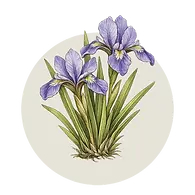
This rare and delicate flower became Michigan’s state wildflower in 1998. Found primarily along the northern shores of Lakes Michigan and Huron, it is endemic to the Great Lakes region. Growing low to the ground and blooming in shades of blue to violet, the dwarf lake iris thrives in the unique microclimates created by the lakes and Michigan's statewide network of rivers, streams and creeks. Its limited range makes it a symbol of Michigan’s ecological uniqueness and the importance of preserving fragile habitats.
STATE TREE
Eastern White Pine
Pinus strobus

Adopted in 1955, the eastern white pine stands as a towering symbol of Michigan’s logging era. Once dominating the state’s forests, these trees fueled the 19th-century lumber boom that helped build cities across the Midwest. Known for their great height and straight trunks, they were also prized for ship masts. Today, surviving stands evoke both natural grandeur and a reminder of the state’s transformation through industry.
STATE GEM
Isle Royale Greenstone
Chlorastrolite

Literally meaning “green star stone,” chlorastrolite was designated Michigan’s state gem in 1973 and is found primarily on Isle Royale in Lake Superior. Formed within ancient volcanic rock, it reveals distinctive, radiating “turtleback” or starburst patterns in shades of green when polished; no two stones are alike. Because Isle Royale is a protected national park, collecting is prohibited there, making legally found specimens from the nearby Keweenaw Peninsula especially prized. Rare and regionally unique, it remains one of the most distinctive state gems in the US.
STATE FOSSIL
Mastadon
Mammut americanum

Michigan’s state fossil, designated in 2002, reflects a time when Ice Age giants roamed the region. Mastodons, though they resembled modern elephants, were well adapted to Michigan’s post-glacial forests, feeding primarily on leaves, twigs, and conifer branches rather than grasses. Numerous mastodon remains have been discovered across the state, particularly in peat bogs and wetlands where oxygen-poor conditions allowed for exceptional preservation. Amogst North America's most abundant, these discoveries provide valuable insight into Michigan’s prehistoric ecosystems.
STATE "MASCOT"
Wolverine
Gulo gulo

Though famously known as “The Wolverine State,” Michigan has little historical evidence of a significant native wolverine population. The nickname likely arose in the 19th-century, possibly as a term for the state’s rugged frontiersmen, many f them fur traders. The animal itself, a fierce, solitary member of the weasel family, is native to more remote northern regions. The last confirmed wild wolverine sighting in Michigan occurred in 2004, making it a rare and fittingly mythic emblem of the state’s identity.
STATE BOOK
The Legend of Sleeping Bear
Wargin and Frankenhuyzen

The Legend of Sleeping Bear tells an enduring Anishinaabe story of a mother bear and her two cubs fleeing a great forest fire along the western shores of Lake Michigan. Reaching the water, they attempt a desperate swim to safety, but the cubs fall behind and disappear beneath the waves. The grieving mother waits endlessly on the eastern shore, watching for their return. Moved by her devotion, the Great Spirit transforms the cubs into the Manitou Islands and the mother into the Sleeping Bear Dunes. It was officially designated Michigan’s State Children’s Book in 1998.
STATE FLAG
Adopted 1911
Heraldic symbol

The State of Michigan's flag prominently features the state’s coat of arms set against a deep blue field, a design closely tied to the banners carried by Michigan regiments during the American Civil War. Its composition reflects the state’s firm allegiance to the Union, echoing the blue of federal military colors under which its soldiers served. At the center, the familiar imagery of the seal reinforces themes of peace, vigilance, and frontier resilience, while the surrounding elements connect Michigan’s identity to both national unity and its own natural heritage.
STATE QUARTER
Issued 2018
America the Beautiful Quarters Series

The Pictured Rocks quarter celebrates the striking shoreline of Pictured Rocks National Lakeshore along Lake Superior. The reverse depicts Chapel Rock, a solitary pine-topped formation connected to the mainland by a narrow natural arch, set against the vivid sandstone cliffs that define the region. Shaped by wind, water, and ice, the scene highlights both the geological drama and fragile beauty of one of Michigan’s most iconic natural landscapes.
STATE BIRD
American Robin
Turdus migratorius

More commonly known as the red-breasted robin, the American robin was chosen as Michigan’s state bird in 1931. Its cheerful song and early spring arrival make it a beloved harbinger of warmer days after long Great Lakes winters. Robins are remarkably adaptable, equally at home in forests, suburbs, and city parks. Although a migratory species, a fair number of robins now spend their winters in Michigan, sustained by berries rather than their usual diet of worms.
STATE DUCK
Wood Duck
Aix sponsa

One of North America’s most striking waterfowl, the wood duck was named Michigan’s state duck in 1985. Known for its iridescent plumage and distinctive crest, the species thrives in wooded wetlands, rivers, and marshes across the state. Unlike most ducks, it nests in tree cavities (often high above the water) leading to the remarkable sight of ducklings leaping from the nest shortly after hatching. Its recovery from near-extinction in the early 20th-century is a conservation success story closely tied to habitat protection in the Great Lakes region.
STATE REPTILE
Painted Turtle
Chysemys picta

Michigan’s state reptile since 1995, the painted turtle is the most widespread turtle species in North America and a familiar sight in ponds, lakes, and slow-moving rivers; its selection was notably championed by Michigan schoolchildren through classroom civics projects. Its name comes from the bright red and yellow markings along its shell and limbs. Notably hardy, painted turtles can survive Michigan winters by hibernating underwater, tolerating extremely low oxygen conditions, an impressive adaptation to the state’s climate.
STATE FLOWER
Apple Blossom
Malus coronaria

Chosen in 1897, the apple blossom reflects Michigan’s long-standing identity as one of the nation’s leading fruit producers, an industry rooted in both geography and climate. Each spring, orchards across the state erupt in delicate pink-and-white blooms, transforming the landscape into a fleeting, fragrant canopy that signals renewal after winter. Nowhere is this more evident than along the Lake Michigan “fruit belt,” where the lake’s moderating effect protects blossoms from late frosts, creating ideal conditions for apples, cherries, and other tree fruits.
STATE NATIVE GRAIN
Manoomin
Zizania palustris and Zizania aquatica

Designated in 2014, manoomin, meaning “good berry” in the languages of the Anishinaabe people, is far more than a grain; it is a cultural cornerstone. Naturally growing in the shallow waters of the Great Lakes region, it has sustained Indigenous communities for centuries and has seen as recent resurgence. Traditionally harvested by canoe using time-honored techniques, manoomin remains central to cultural identity, treaty rights, and ecological stewardship. Its designation acknowledges both its nutritional value and its profound cultural significance.
STATE STONE
Petoskey Stone
Hexagonaria percarinata

Named in 1965, the Petoskey stone is a fossilized coral unique to Michigan, formed during the Devonian Period roughly 350 million years ago. Its distinctive hexagonal pattern becomes visible when polished, making it a favorite among collectors. Found along the shores of Lake Michigan and Lake Huron, it connects Michigan's present landscape to an ancient tropical sea that once covered the region, a striking reminder of deep geological time.
STATE MINERAL
Copper
Cu
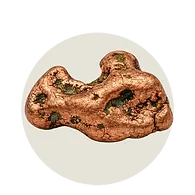
Designated Michigan’s state mineral in 2013, copper is found in remarkable native form across the Keweenaw Peninsulaalong the shores of Lake Superior. Unlike most copper deposits worldwide, which occur in ores, Michigan’s copper often appears as pure metal, sometimes weighing many tons. Formed within ancient volcanic rock over a billion years ago, it fueled one of North America’s earliest mining booms and played a vital role in the region’s industrial heritage. Geologically unique, native copper remains one of the most iconic natural symbols of Michigan.
STATE SOIL
Kalkaska Soil
Sandy, isotic, frigid Typic Haplorthods

Named in 1990, Kalkaska sand represents the widespread sandy soils left behind by retreating glaciers. Found extensively across northern Michigan, it is well-drained and low in natural fertility, yet it supports important forest ecosystems, especially pine. Its coarse texture allows water to percolate quickly, shaping both vegetation patterns and land use across the region. Its designation highlights the profound influence of glaciation on Michigan’s landscape, shaping everything from vegetation patterns to agriculture and settlement.
STATE BEVERAGE
Milk
-

Designated as Michigan’s official state beverage in 2005, milk reflects the state’s deep agricultural roots and strong dairy industry. With its fertile soil, abundant water, and temperate climate, Michigan supports hundreds of dairy farms producing millions of gallons annually. Beyond its economic importance, milk symbolizes nourishment and everyday life, from school lunches to local creameries. Its selection highlights both the legacy of family farming and Michigan’s role as a leading agricultural state in the Great Lakes region.
STATE SEAL
Adopted 1835
Heraldic symbol

The Great Seal of State of Michigan reflects both its wilderness setting and early frontier realities. At its center stands a man with a raised hand symbolizing peace, while holding a rifle to signify readiness to defend the territory and its settlers during a time of border disputes and uncertainty, notably around the period of the Toledo War. He is set against a peninsula landscape with a rising sun, representing hope and a new beginning. Flanking the shield are a moose and an elk, emblematic of Michigan’s wildlife, while the bald eagle above affirms its place within the US.
STATE QUARTER
Issued 2004
50 State Quarters Series

The Michigan state quarter highlights the state’s defining relationship with the Great Lakes. The reverse features a map of Michigan set against an outline of the surrounding lakes, emphasizing its unique geography as the only state comprised of two peninsulas bordered by four of the five Great Lakes. Inscribed with the phrase “Great Lakes State,” the design underscores Michigan’s maritime heritage, economic reliance on freshwater resources.
STATE QUARTER
Issued 2025
American Women Quarters Series

The Dr. Vera Rubin quarter honors the groundbreaking astronomer whose research provided compelling evidence for dark matter. The reverse portrays Vera Rubin gazing upward amid a field of stars and spiral galaxies, reflecting her pioneering study of galactic rotation. Her scientific legacy is closely tied to University of Michigan, where she earned her doctoral degree and conducted early research, linking her achievements to Michigan’s long-standing tradition of excellence in astrophysics and scientific inquiry.
